







A grocery chain having a rough year found one number worth bragging about — and it says more about how AI changes buying behaviour than about groceries.
The short version
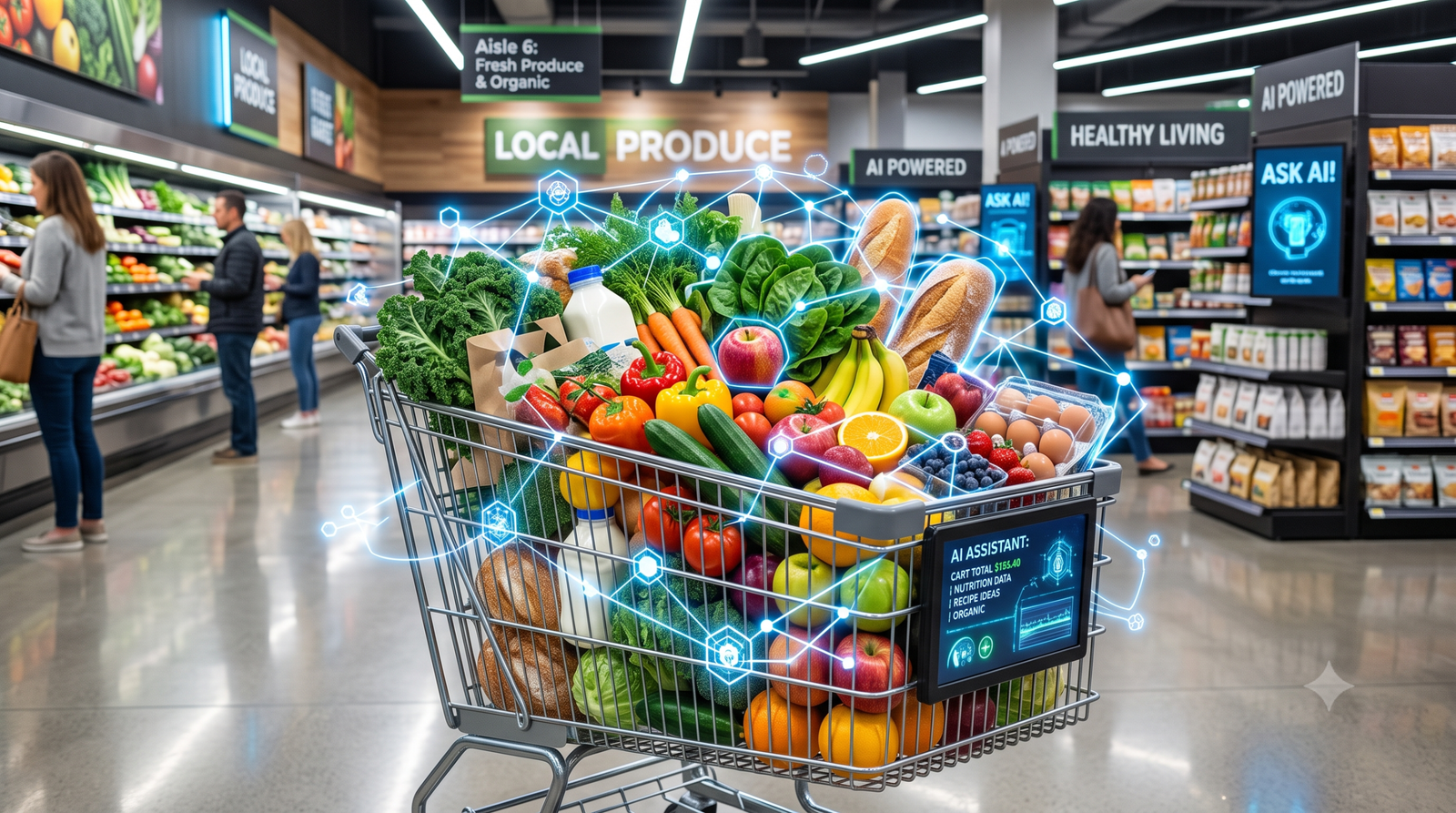
Albertsons — the 2,240-store operator behind Safeway, Vons, Jewel-Osco and 19 other banners — has put a number on what its AI shopping tools are worth. Shoppers who use its conversational search spend roughly 10% more per order. Shoppers who use the fuller assistant, the one that builds meal plans and matches ingredients to dietary preferences, spend about 26% more.
Those figures came from Jill Pavlovich, the company’s SVP of digital customer experience, in a Wall Street Journal interview earlier this month. They arrive in the middle of an uncomfortable year: pharmacy and digital have carried growth while physical store sales have sagged against what the company describes as a more cautious, inflation-wary consumer.
So the headline writes itself — AI saves the grocery run. The more useful question for anyone running a commerce or demand-gen function is narrower: what exactly did the AI change?
It didn’t make people buy more. It stopped them leaving early.
Pavlovich’s own explanation is the most instructive part of the story, and it has nothing to do with persuasion. Traditional site search is a spearfishing exercise: you know the item, you type the item, you get the item, you leave. One query, one product, one line on the receipt.
A conversational assistant breaks that loop. Ask it for a week of vegetarian dinners for six with leftovers, and it returns a basket — a proposition spanning categories the shopper was never going to browse into individually. Nobody was upsold. The interface simply stopped truncating intent at the first match.
That’s the mechanism worth stealing, and it generalises well beyond grocery:
- Keyword search rewards shoppers who already know the answer. Everyone else abandons.
- Conversational discovery converts a vague, messy need into a structured multi-item outcome. More items per session is a by-product, not a trick.
- The lift concentrates where the job-to-be-done is complex. Note the spread: 10% for basic conversational search, 26% for the recipe-and-dietary assistant. The harder the planning problem you absorb on the customer’s behalf, the bigger the basket.
- If your category involves configuration, bundles, compatibility, compliance or planning — B2B software stacks, industrial parts, travel, insurance, professional services — that 26% gap is the part of the story to read twice.
Now the caveats nobody puts in the press release
Be honest about what these numbers do and don’t establish.
- Self-selection is doing unknown work. People who opt into an AI meal planner are, almost by definition, planning. Planners were always going to buy more than someone dashing in for milk. Without a holdout group, “AI users spend 26% more” and “AI causes a 26% lift” are not the same claim.
- AOV is not incremental revenue. A bigger online basket that cannibalises a store trip moves the mix, not the total. Albertsons’ own results — soft in-store sales, healthier digital — are consistent with exactly that.
- Albertsons has not claimed a clean ROI. By Pavlovich’s account the basket lift showed up almost immediately after rollout; the return on the underlying investment did not. That gap between behavioural signal and financial payoff is the honest state of enterprise AI right now, and it’s why the company is consolidating its separate Ask AI, Plan AI and Buy AI tools into a single assistant. Three half-adopted tools generate three sets of costs and one confused customer.
The broader benchmarks point the same way. McKinsey’s retail work puts AI-driven pricing at roughly two to five points of gross margin, predictive assortment at 15–30% fewer markdowns and stockouts, and AI supply-chain management at 10–20% lower inventory costs. Real money — but earned in the back office, not the chat window. The customer-facing assistant is the visible part of a much less photogenic system.
The strategic move: getting agent-ready
The Safeway plugin inside ChatGPT, live since 5 August, is the tell. Shoppers browse, build a cart and adjust items inside OpenAI’s interface, then get handed back to Safeway for checkout. Pavlovich’s framing was that the plugin makes shopping “as simple as having a conversation.”
Read that as a distribution decision, not a feature launch. Albertsons is placing its catalogue where discovery is migrating, accepting that it no longer controls the top of the funnel. The retailer that owns the checkout but rents the conversation is in a different business than the one that owned both.
Which makes the unglamorous work the actual competitive moat: clean product data, live pricing, accurate availability, structured attributes, fulfilment APIs an external agent can query without hallucinating. An assistant is only as good as the catalogue underneath it. Most of the losers in agentic commerce will lose on data hygiene, not on model choice.
What to take into your own roadmap
- Instrument before you celebrate. Run a holdout. Report incremental revenue per user, not AOV among adopters. Every vendor pitch you hear this year will quote the adopter number.
- Point AI at your most complex buying journey, not your simplest. Simple journeys are already solved; the lift lives in the complicated ones.
- Consolidate assistants. One surface that does five things beats five surfaces that each do one.
- Fix the data layer first. Attributes, availability, pricing, entitlements. This is the boring prerequisite for everything above.
- Assume third-party agents are a channel. Decide now whether you show up in them on your terms or theirs.
- Watch the P&L, not the demo. Behavioural lift arrives in weeks. Financial return takes considerably longer, and only for teams who treat AI as operating model rather than feature.
Albertsons has produced one of the cleaner pieces of evidence that conversational commerce changes how people shop — and, at the same time, a reminder that changed behaviour is not the same as changed economics. The company’s top and bottom line have not been transformed. A basket has.
For marketers, that’s not a disappointment. It’s a sequencing lesson. Behaviour moves first, margin follows the operators who wire AI into pricing, assortment, supply chain and data — and it never arrives at all for the ones who stopped at the chat widget.