









A profitable startup with money in the bank still chose an exit at a 94% discount.
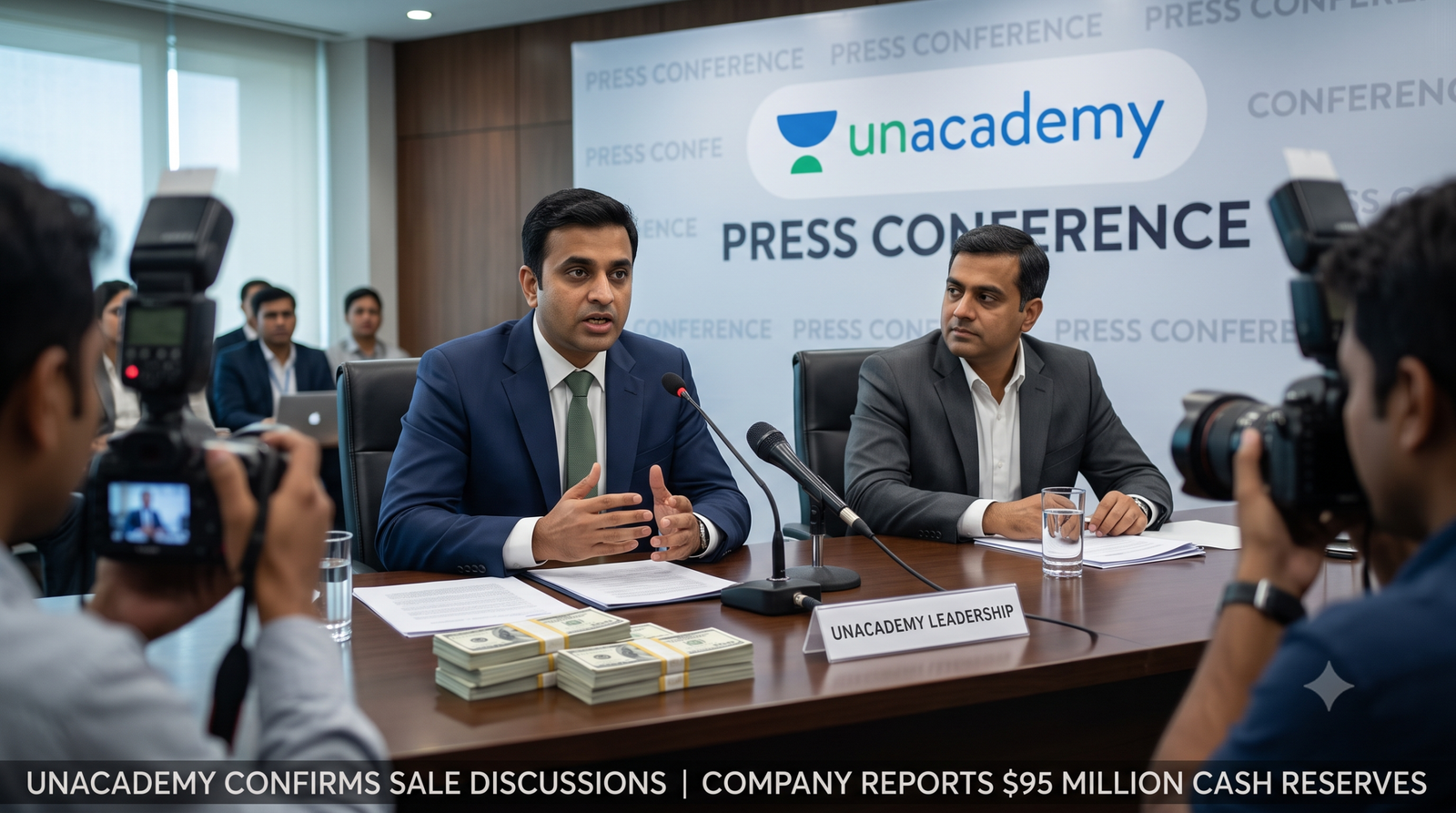
Gaurav Munjal didn’t have to sell. Unacademy had roughly ₹9 billion — about $94.8 million — sitting in the bank, annual revenue near ₹4 billion ($42.13 million), and most of its businesses at or near profitability. He sold anyway, at ₹19.55 billion (about $206 million). In 2021, investors valued the company at $3.44 billion.
The math nobody dressed up
The all-stock deal closed this week, roughly six months after upGrad announced it in March. Unacademy shareholders take upGrad stock; angel investors got cash at closing, according to upGrad chairperson Ronnie Screwvala. Munjal’s own summary on X was blunt: they raised at a peak and sold at a fraction of it, and he wasn’t going to pretend otherwise.
That’s a 94% haircut on a company that raised about $880 million across 13 rounds from SoftBank, Tiger Global, and General Atlantic. It is also, by Munjal’s account, a voluntary one. Nobody forced it. The company could have kept operating alone.
Why sell a profitable business
The reasoning was about ceiling, not survival. Two sources familiar with the deal said leadership concluded that reaching real scale — or an eventual IPO — meant covering far more of the education market than Unacademy did. upGrad already has the offline footprint. Buying the route was faster than building it.
Unacademy’s decline had a clear arc. Founded in 2015, it spent aggressively through 2020 and 2021 fighting Byju’s for students and teachers while lockdowns pushed online learning demand up. Classrooms reopened, demand collapsed, and the company cut costs, laid off staff, and restructured. It got back to near-profitability. It just couldn’t get back to growth on its own terms.
What upGrad actually bought
- Full group — PrepLadder and Graphy included, Unacademy brand retained
- Airlearn — language app, 10 million users across 150+ countries
- The team — about 1,000 employees, no layoffs planned
- Leadership — Munjal stays CEO, focused on online and Airlearn
Airlearn is the piece worth watching. It’s two years old, about 25 people, and Screwvala called the business one upGrad is very excited about. Munjal had term sheets for it from outside investors late last year before dropping those talks for upGrad. In roughly six months, the two will decide whether to fund it internally or raise externally.
The backdrop is brutal. Byju’s, once worth $22 billion and India’s most valuable startup, saw its valuation fall to effectively zero and entered insolvency in 2024. Against that, a 94% markdown with jobs intact reads almost like a win.
Category ceilings beat unit economics. Unacademy was profitable and still concluded it couldn’t reach IPO scale in the slice of education it owned. If you’re a founder or operator staring at a good margin in a narrow category, the decision this should influence is whether your addressable market can carry an exit — and whether buying reach is cheaper than building it.
The uncomfortable question: how many other profitable Indian startups are quietly running the same math right now?
TAGS: Edtech, Startup Funding, Mergers And Acquisitions, Down Round, India Startup Ecosystem, Online Learning, Startup Exit Strategy, Unacademy, upGrad, Airlearn, Byju’s, Founders, Enterprise Tech